Engines breathe; the earth answers. In this uneasy rhythm, where wires stretch like roots and circuits hum with electric strain, a fine balance holds.
Here, nature and its rival coexist: alive, unstable, and pulled by opposing forces.
The exhibition begins with a feeling that resists settling. Movement flickers at the edges of sight, and the air whispers faintly as if holding its breath. There’s a tension: the organic pressing against the industrial, finding gaps to thrive. Figures morph, fragment, and expand, suspended between urgency and tranquility.
As we move further, the environment unfolds into cycles. Nature rises tall against the bones of forgotten factories, and unseen waves carry echoes of stories left behind. Sand erases the future, and ice leaves only a fleeting trace. Everything evolves, adapts, and becomes something new — not as it was, but as it could be.
This exhibition is part of the ESC 2034 trilogy, continuing where Machine Echoes left off: an exploration of the elusive balance between nature, technology, and humanity. Born from the open call A Decade into the Future, it marks 0—1 Gallery’s shift from the digital to the tangible. Each chapter unites a unique group of artists to reimagine how these forces collide, interact, and form what lies ahead.
Artists
Shay Salehi
Sensitive Dependence on Initial Conditions, 2023
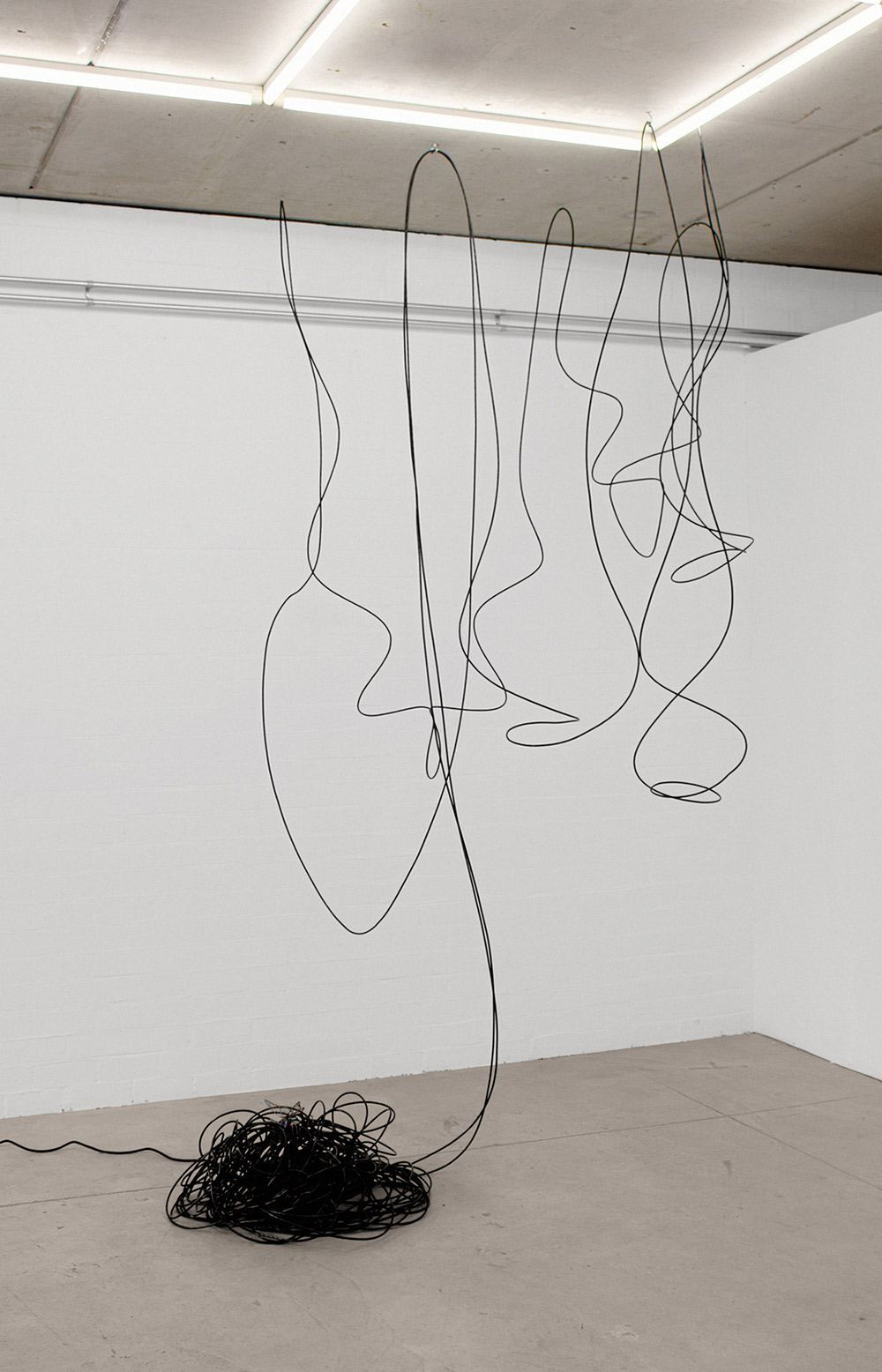
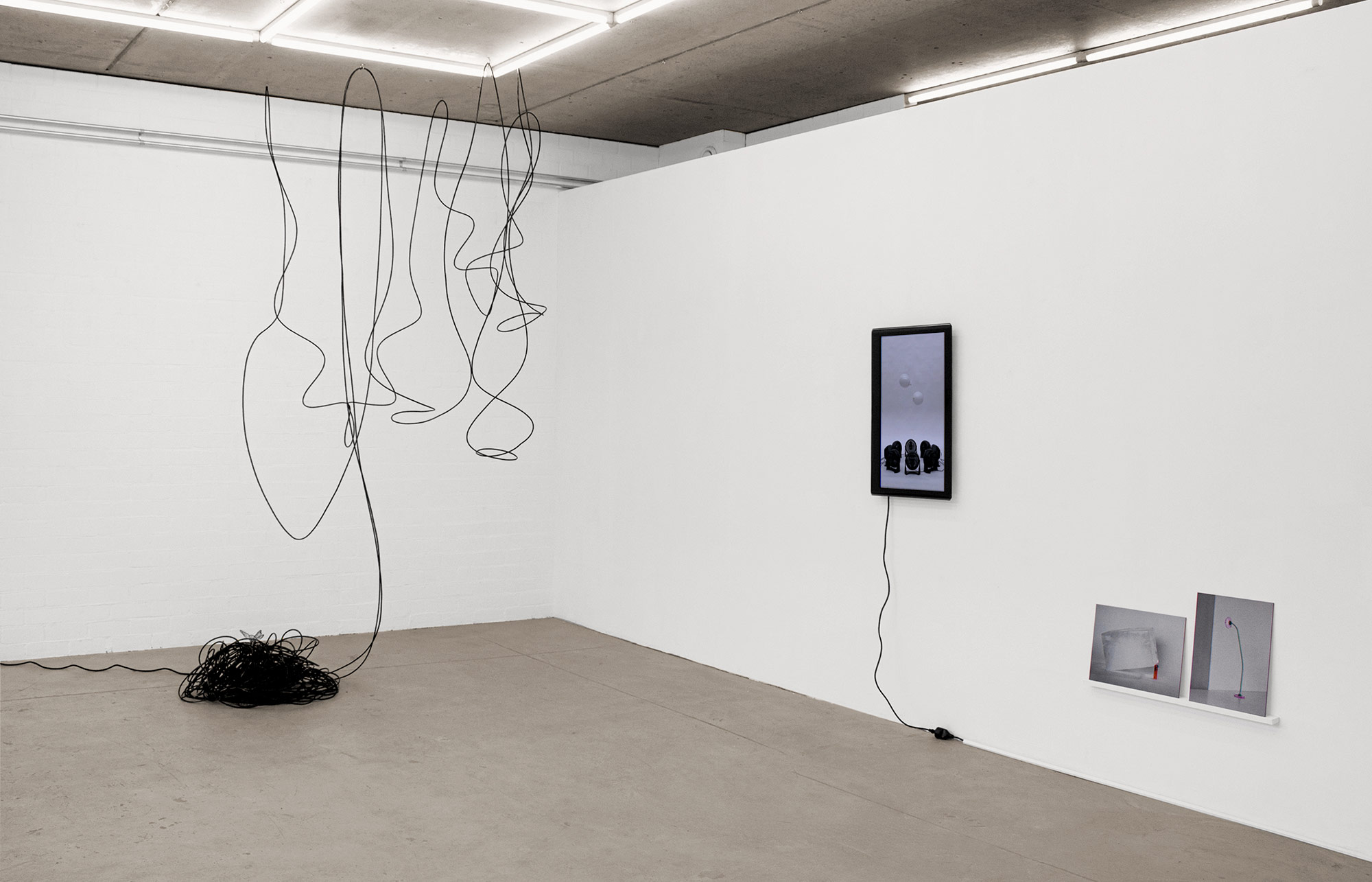
Somewhere between strength and surrender, a butterfly moves. Its wings tremble beneath the weight of an industrial cable that snakes across the room, heavy and unmoving. The butterfly, delicate but determined, holds its ground. This is Sensitive Dependence on Initial Conditions (2023), where the fragile doesn’t disappear — it insists on staying.
Salehi’s work is rooted in her meditation on the complex relationship between humans and non-human beings. Her practice interrogates systems of ownership, power, and exploitation, questioning how industrial frameworks reshape the natural world at great cost. She draws soft connections, tying species, spaces, and histories in ways often ignored.
Her installations stand with a deliberate presence, carving out space for the questions progress leaves unanswered. The movement travels through her wider body of work. An adjustment here, a pulse there — tenacity that remains understated yet stays with you long after. Whether it’s the flutter of a butterfly or the dim suggestion of life breaking through the mechanical, her pieces inhabit a threshold where vulnerability asserts itself.
The butterfly’s presence embodies this quiet resolve, turning our gaze toward what remains unshaken as the world orbits around it.
Can Sun
Absurd Poetry, 2021–2023
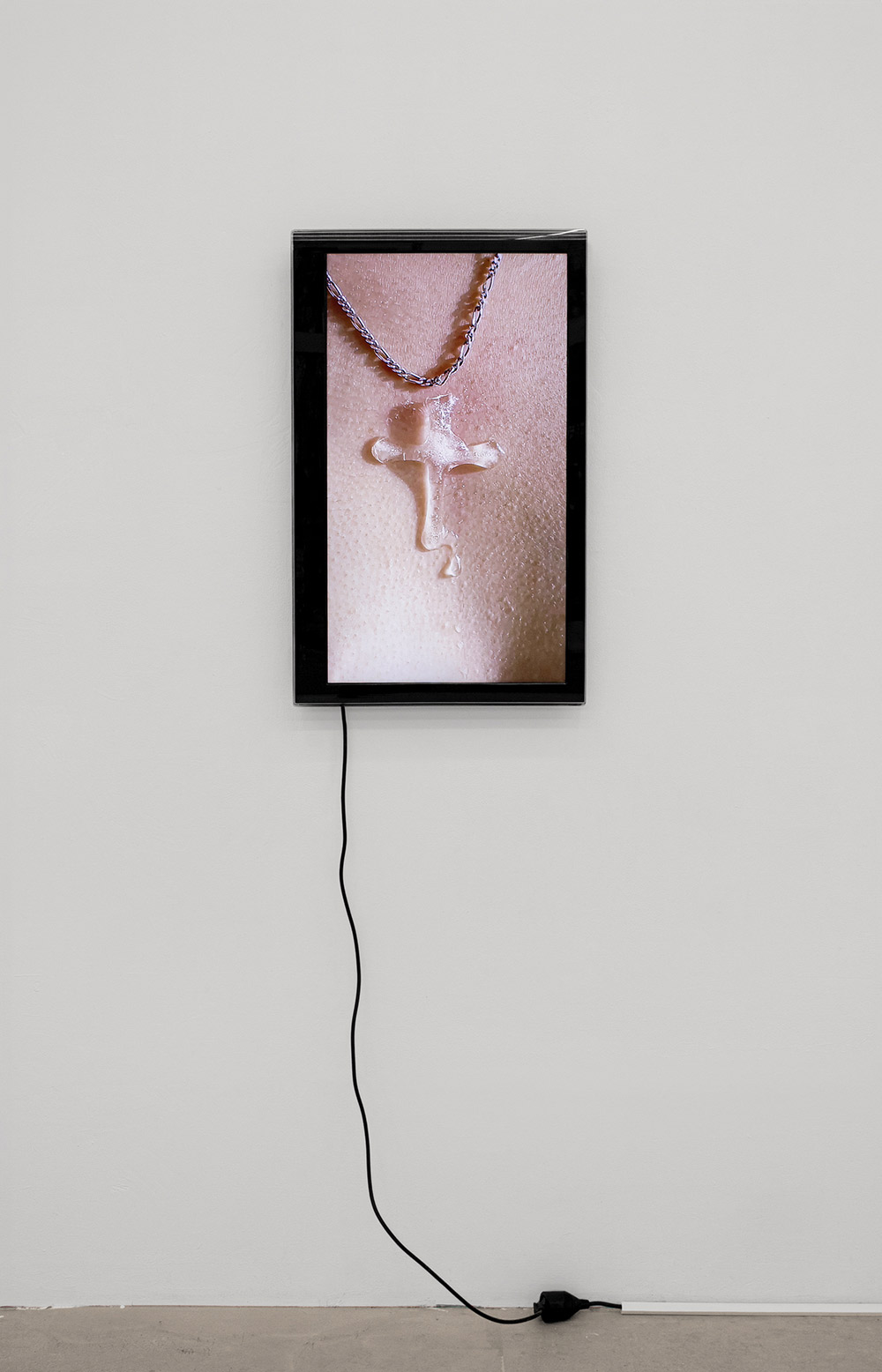
The familiar isn’t always what it seems. In Can Sun’s world, everyday objects morph into something stranger, their edges blurring just enough to feel both playful and unsettling. His works exist between humor and critique, pointing at the absurdities woven into industrial systems and technological progress.
In Absurd Poetry (2021–2023), Sun transforms everyday items such as tomatoes, flowers, and ice into temporal sculptures that balance between humor and critique. These works reflect his disconnection, driven by alienation in a hyper-industrialized world, offering moments where the ordinary tilts into the surreal.
At its core, Sun’s practice explores the environments we inhabit — physical, social, and emotional. He builds a dialogue between the personal and the collective, following how systems influence not only objects but also the ways we perceive and navigate the world. There’s a fleeting quality to these moments, a sense of being in the midst of what stays and what fades away.
Familiar turns strange, subtly challenging how we create our spaces and how they, in turn, define us.
Tudor Ciurescu
TRAUM, 2023
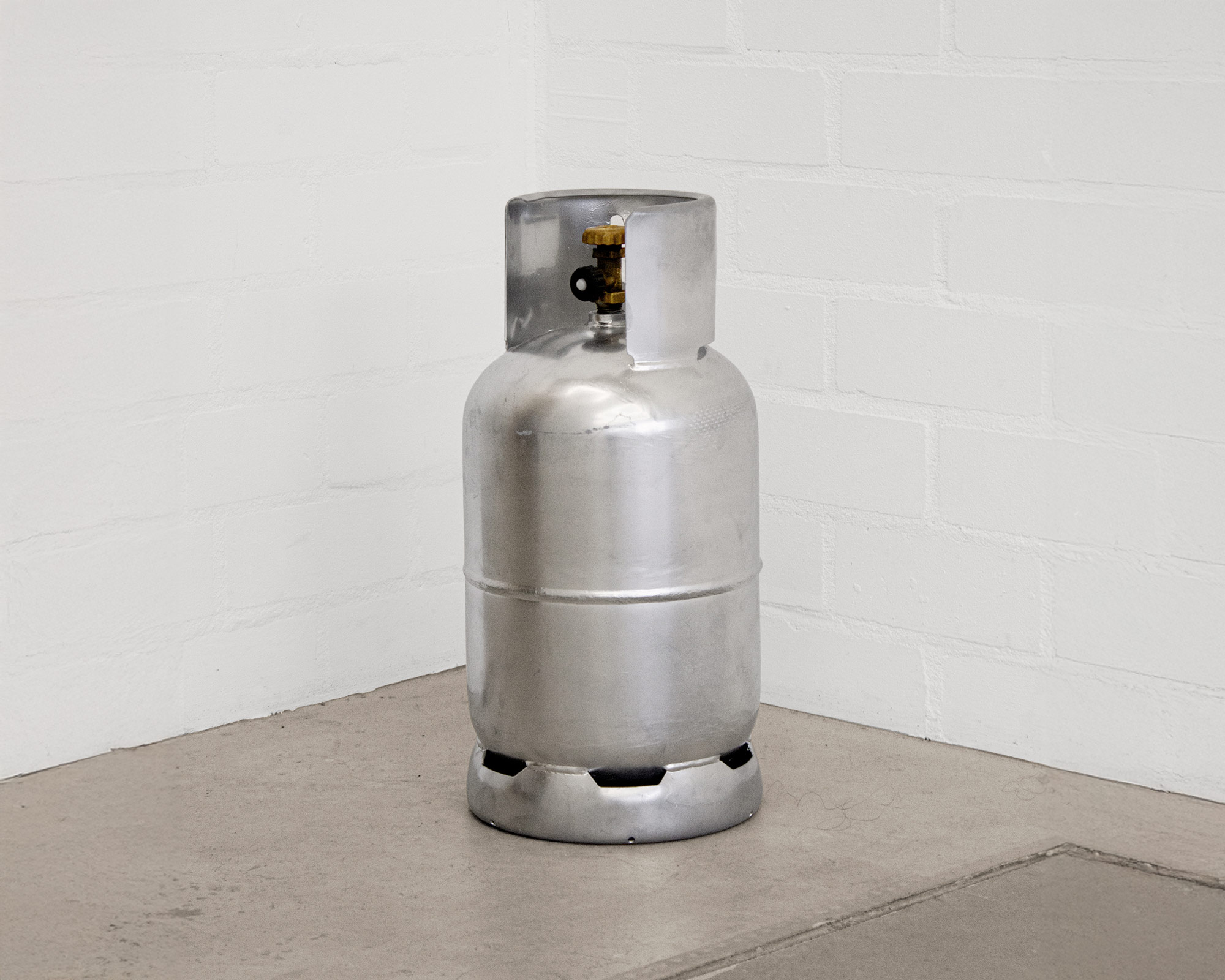
The gas tank stands as if held in permanent stasis, its cold chrome face refusing any suggestion of change. Yet, as you move closer, a distant, sharp exhale punctures the calm — a sound pressed into the air, carrying the weight of warning. In TRAUM (2023), this barely audible sigh alters presence into a stressed edge, where the weight of danger becomes evident.
For Tudor Ciurescu, the hiss is more than sound; it is a conduit for memory and a shadow of systemic weakness. Rooted in childhood recollections of industrial storage tanks and the fear of explosions, the work finds its tension at the intersection of personal experience and societal vulnerability. These memories extend outward, touching broader apprehensions about the reliability of infrastructure — massive, unexamined systems that drone beneath daily life.
Ciurescu’s practice inhabits the missed corners of industrial terrains: factory yards, storage lots, and zones where function gives way to neglect. Through sound and form, he charges these spaces with latent energy, their quietness heavy with the unspoken possibility of failure.
The piece pulls closer, settling into the space where intimate history meets the unease of unstable machines — strained to their limits, holding together just barely.
Mia Dudek
Fruiting Bodies, 2023
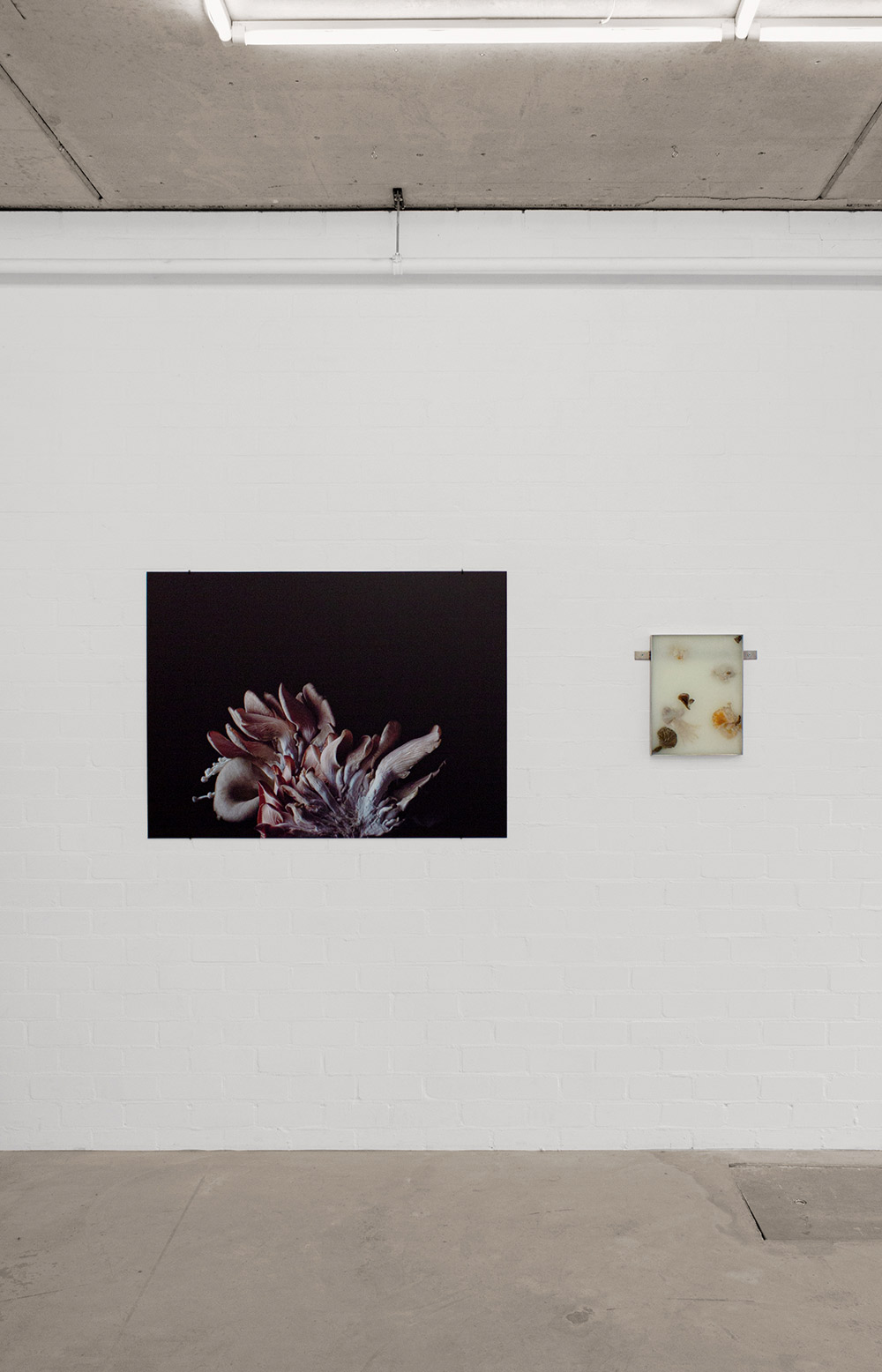
There’s something in the air after rain, an earthy signal that feels barely there. It clings to the corners of things, alive and waiting. In Mia Dudek’s work, this stubbornness follows the subtle intersections where the body, architecture, and the organic brush against each other. Her practice captures what breaks through, bearing down against limits.
Dudek’s work often focuses on the surfaces that divide and connect — skin, walls, thresholds — and the forces that weigh upon them. Her sculptures and photographs reveal moments of conflict where life resists the standstill, finding a way despite everything.
In Fruiting Bodies (2023), pale mushrooms rise from the dark, their growth barely there, but it won’t quit. Encased in resin, they seem frozen in time, alive but not moving. For Dudek, these mushrooms represent life’s lasting power, thriving in neglected spaces and exploding through what confines them. They aren’t loud or assertive, but their presence redefines what was once decayed into something fertile, full of possibility.
What feels invisible takes root in Dudek’s work. She flips impermanence into something tangible, a declaration of vitality in spaces once thought lifeless.
A204
Primal A.I., 2022
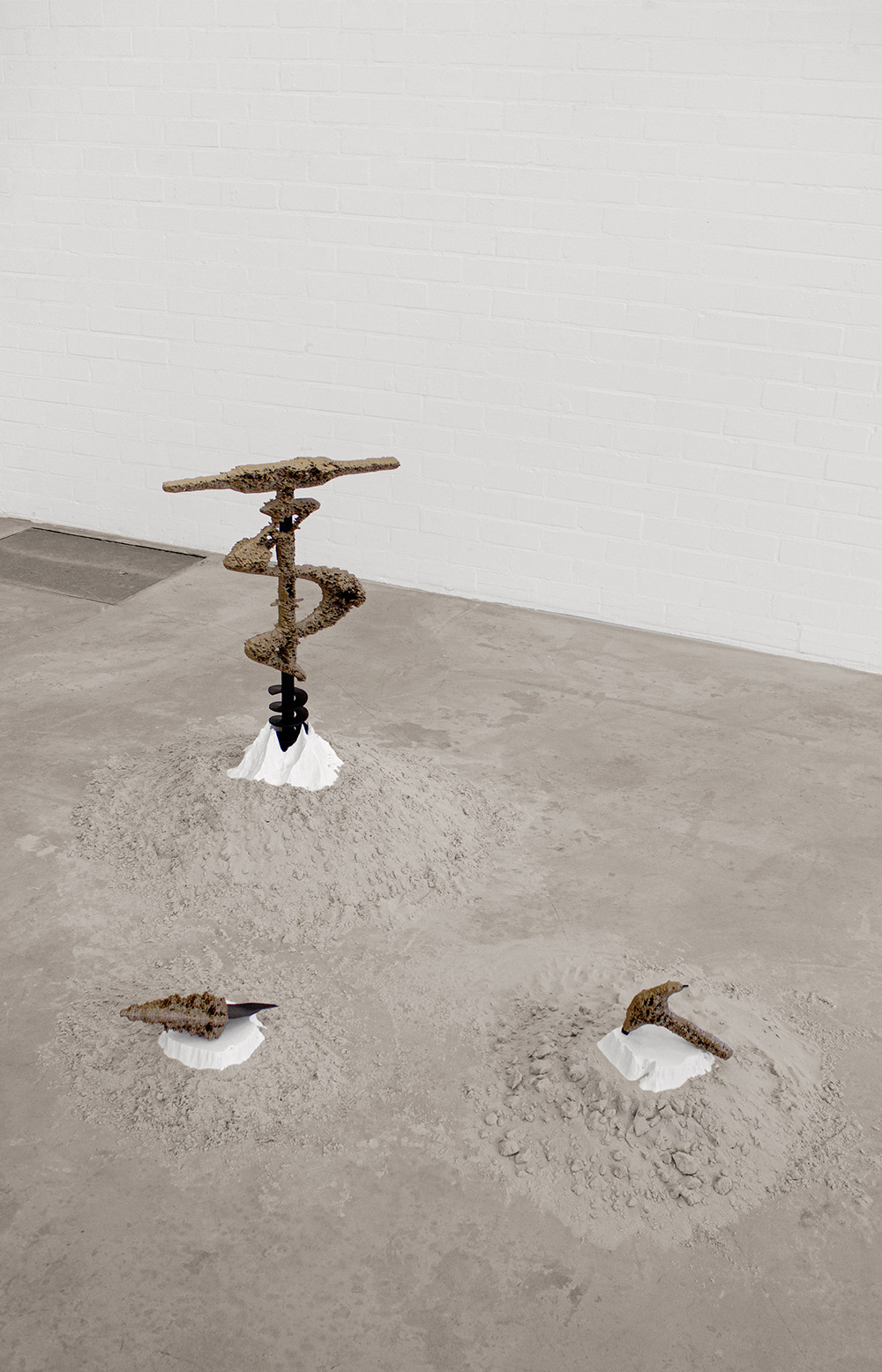
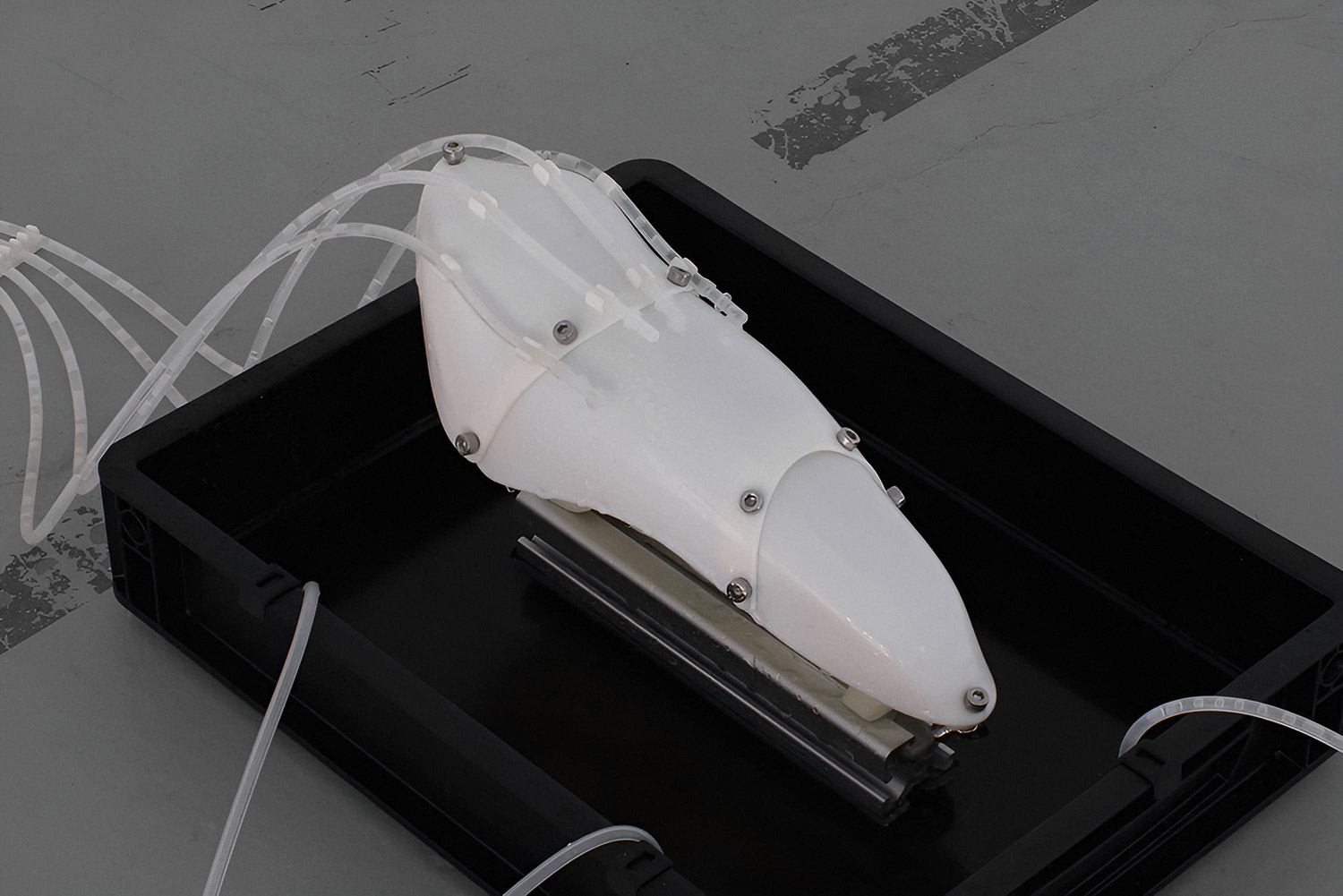
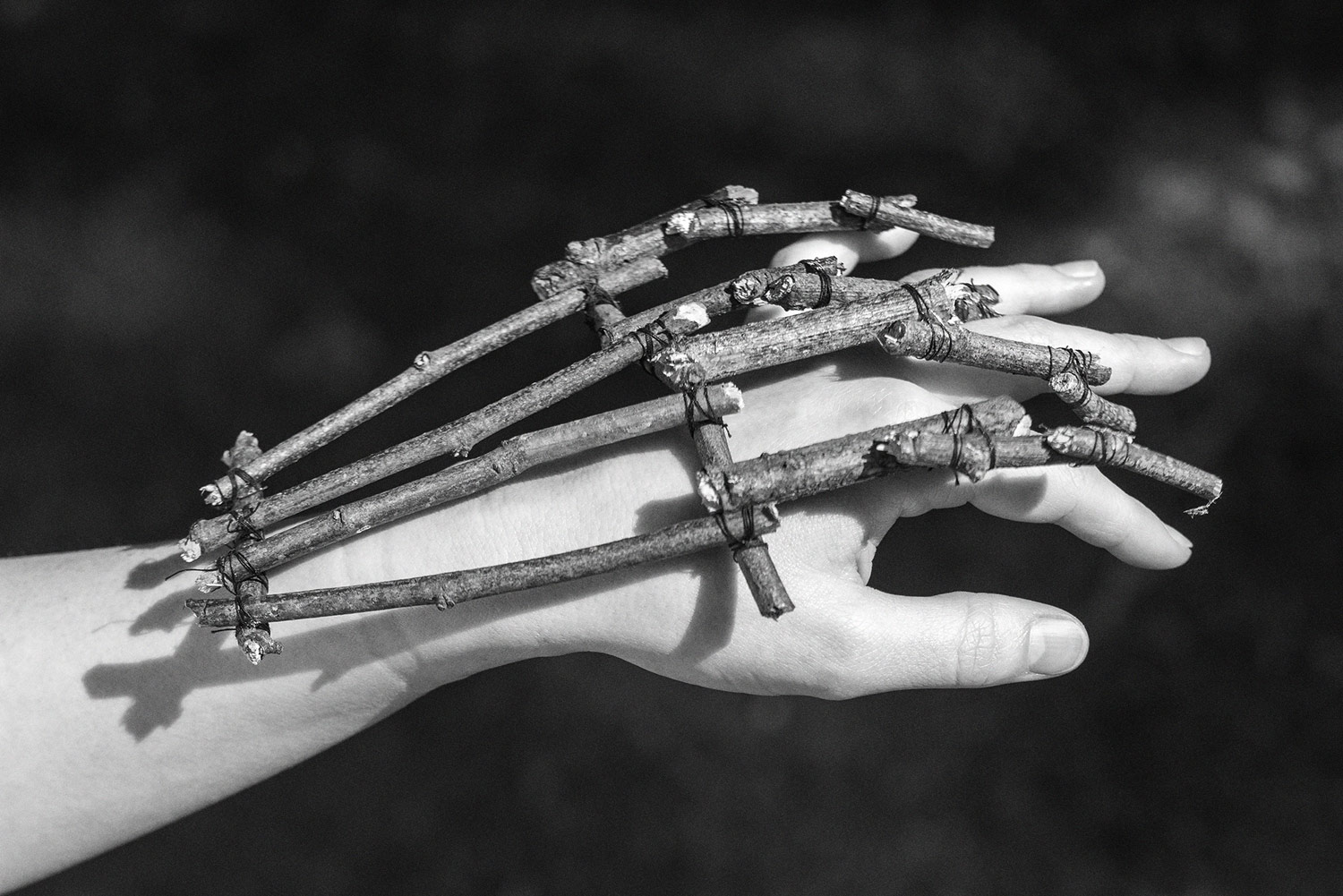
Beginnings carry weight — the heavy labor that brings an idea into the world. In Primal A.I. (2022), that weight becomes something real. Instead of imagining intelligence as sleek or immaterial, it circles back to its origins: raw materials, extraction, and the human hands that make it possible. What remains is fractured and unresolved, questioning what has been built and at what cost.
Its tools are fragments of a system engineered to extract and consume, shaped by processes that mirror the cycles they critique. Created through machine learning, these objects suggest something infinite yet unfinished, caught between speculation and inevitability. The blurred boundary between human intent and computational output deepens their mirage-like presence.
A204 explores where fictional storytelling meets conceptual design, examining how technology and materiality shape the human experience. By grounding intelligence in the physical, their work exposes what progress demands and what is left in its shadow.
This is not a finished world. The tools are more than reminders; they hide a question: How much of what we create justifies the weight it sets in motion?
Cao Shu
Phantom Sugar, 2023
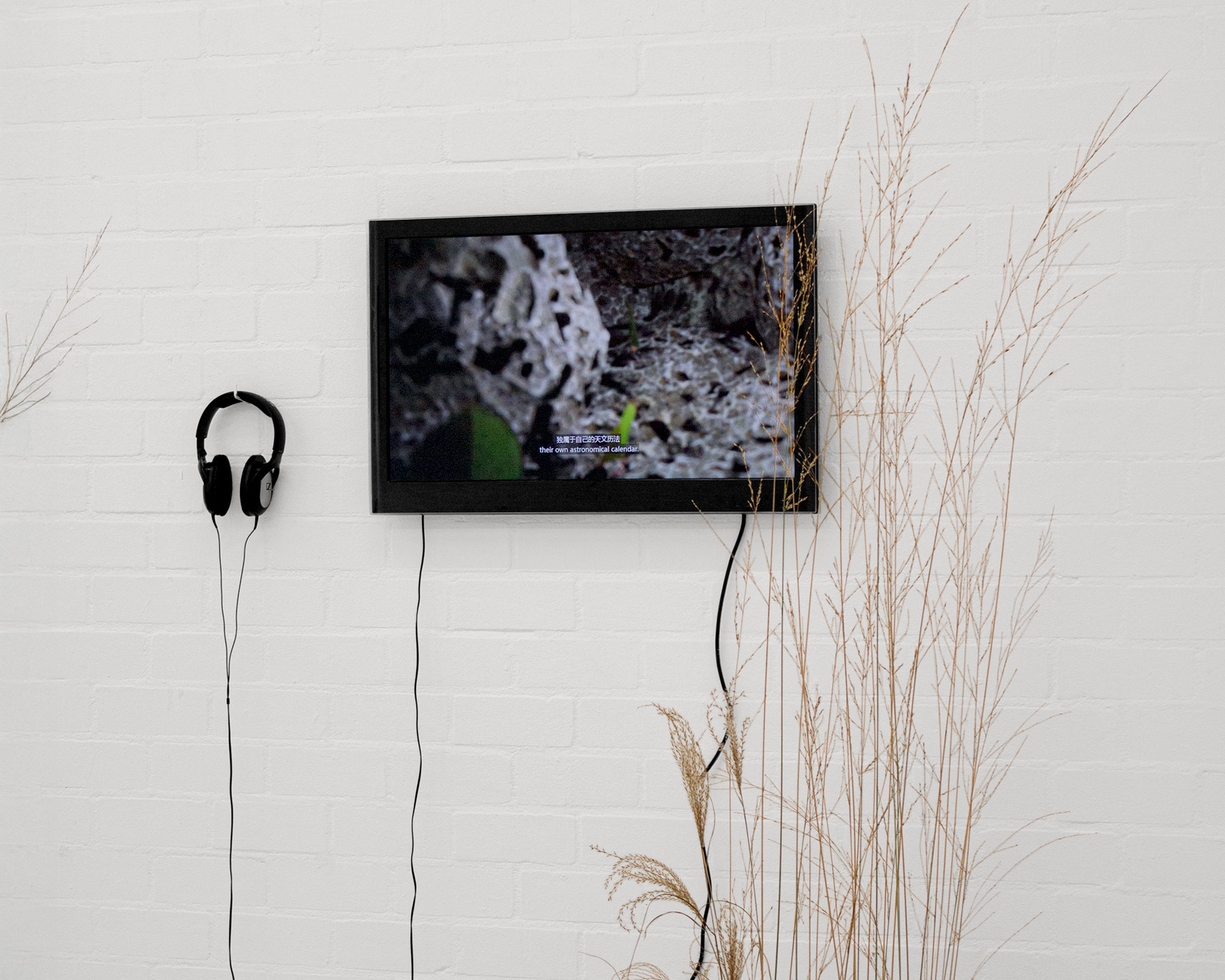
Grass moves free where machines once roared. The walls of an old factory give up their history, and the ground seems to hold onto what was left behind. Cao Shu works in these spaces, where time feels stretched, caught between cycles of growth and loss, revealing fragments of memory and stories buried within.
Through live photography, 3D imagery, and experimental media, Shu maps the remains of ambition — marks that never quite fade. His work rests between memory and presence, holding fragments of time where the past and what might have been seem to share the same.
In Phantom Sugar (2023), sugar becomes the axis of a fragile cycle. The rise and fall of the Guangdong Shunde Sugar Factory come together like a moment caught mid-breath, sweet with the weight of labor and collapse. Shu layers live photography with game engine rendering, pulling history into landscapes that shift as you watch, as if they were never meant to stay still. Sugar becomes more than what it tastes like — it sustains, fractures, and changes the way we build and break, leaving a faint imprint of what was consumed.
The short film paves a parallel between cycles of industry and collapse, capturing the exploitation and uncertainty of what it means to move forward.
Elko Braas
Listening Session, 2021
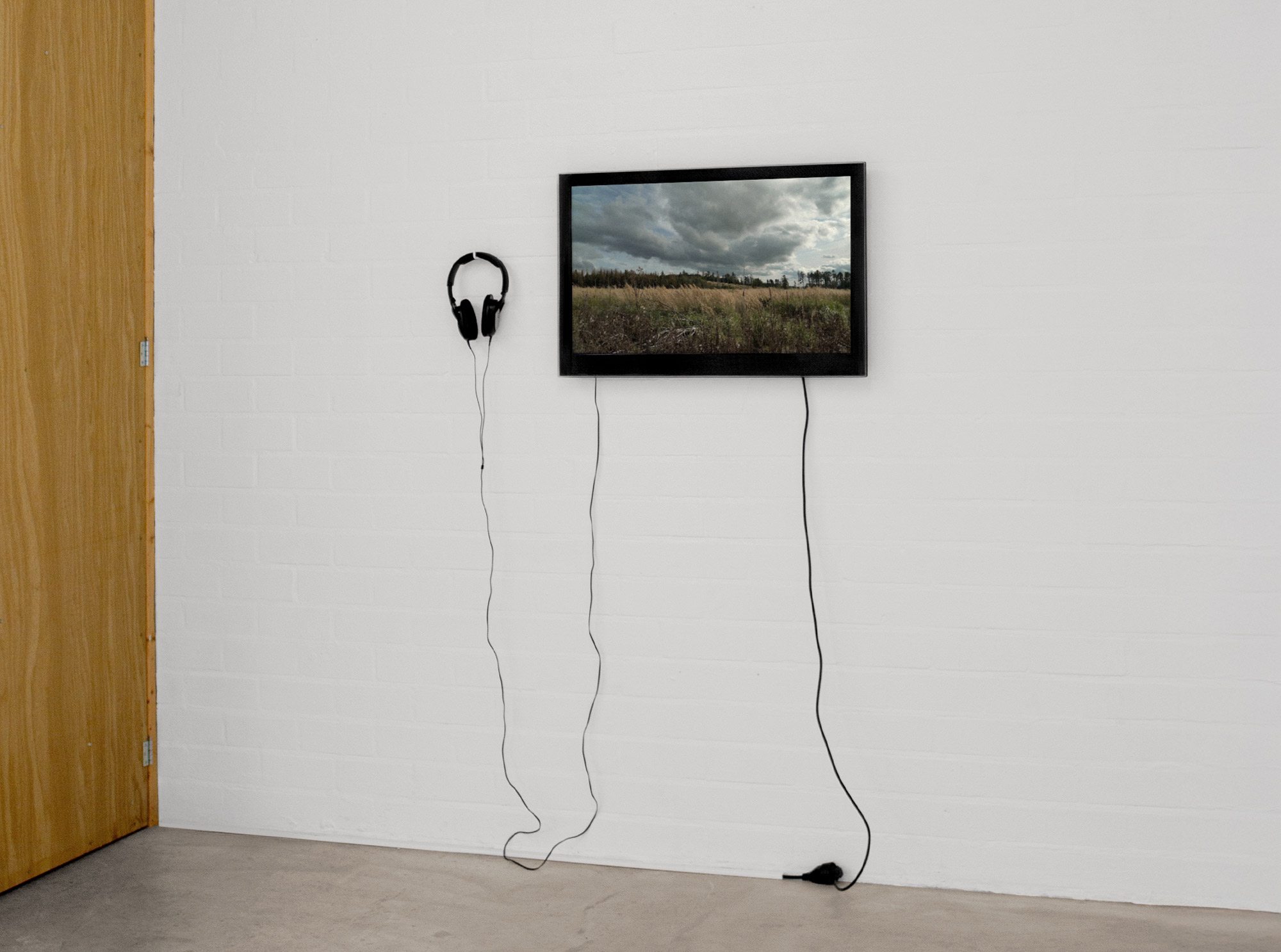
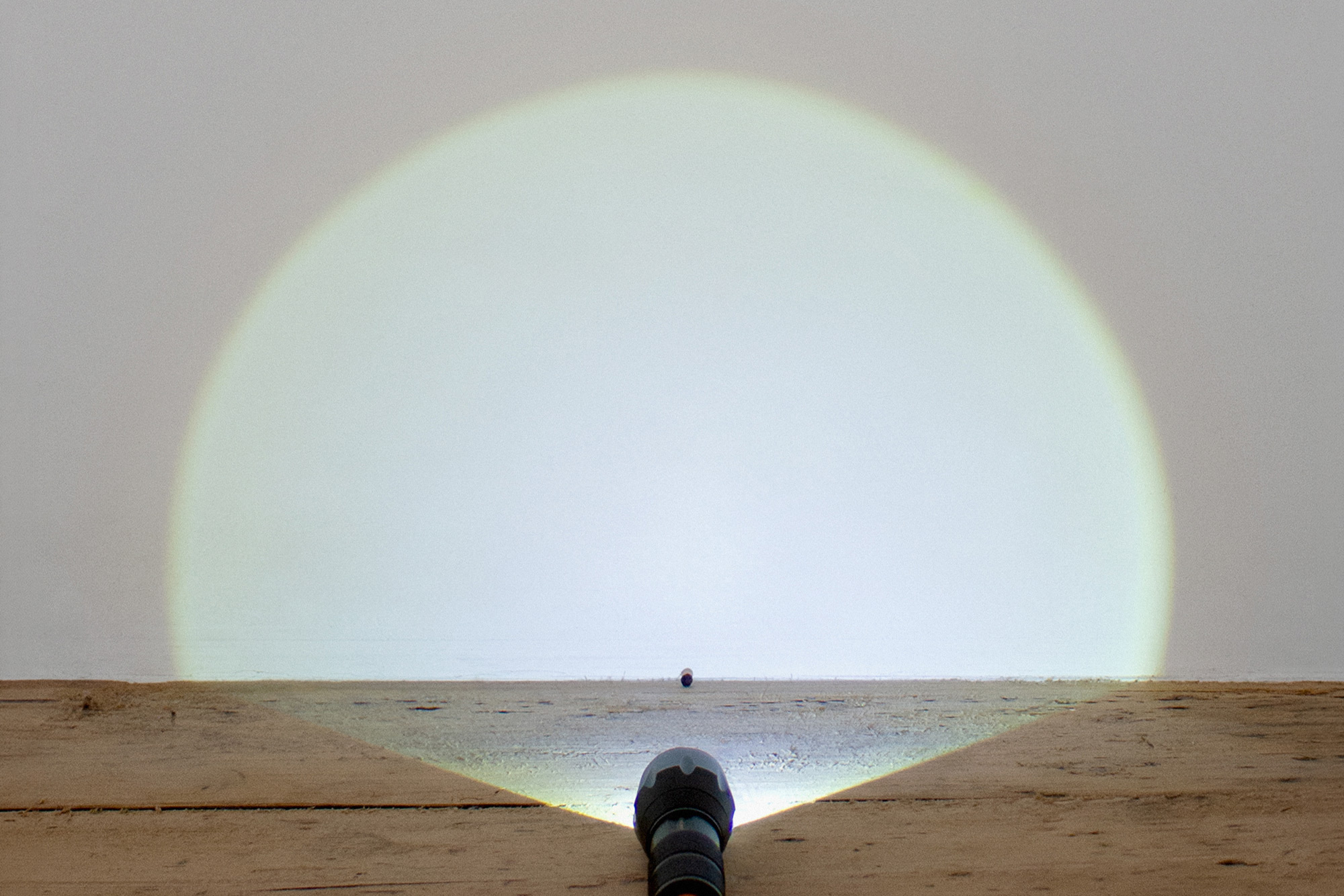
Some sounds drift through the world, distant enough to pass without ever touching our ears. Elko Braas listens to the signals that slip beyond perception — long-wave frequencies carried through the Earth’s magnetic field. An invisible spectrum alive with resonance awakens in Listening Session (2021). The custom-made antennas are built by hand, absorbing the sounds of lightning strikes moving across vast distances, solar winds touching the upper atmosphere, and charged particles finding their path through magnetic currents. These are the forces flowing through existence, binding the natural world in place.
Using long-wave antennas designed with exacting sensitivity, Braas detects very low frequency (VLF) waves — barely there but constant — within atmospheric and geomagnetic interactions. Captured in real-time, they turn into layered soundscapes. Static pulses and transient rhythms, following the energy as it moves through the sky and earth.
The antennas themselves are as much a part of the work as the sounds they catch. Built with precision, each one is tuned to pick up specific frequencies from the air. Every recording reflects a brief exchange between Braas’ tools and the natural forces they engage.
Braas reminds us of a kind of listening the world has always been waiting for.
Kelly Kroener
Metamorphosis, 2022
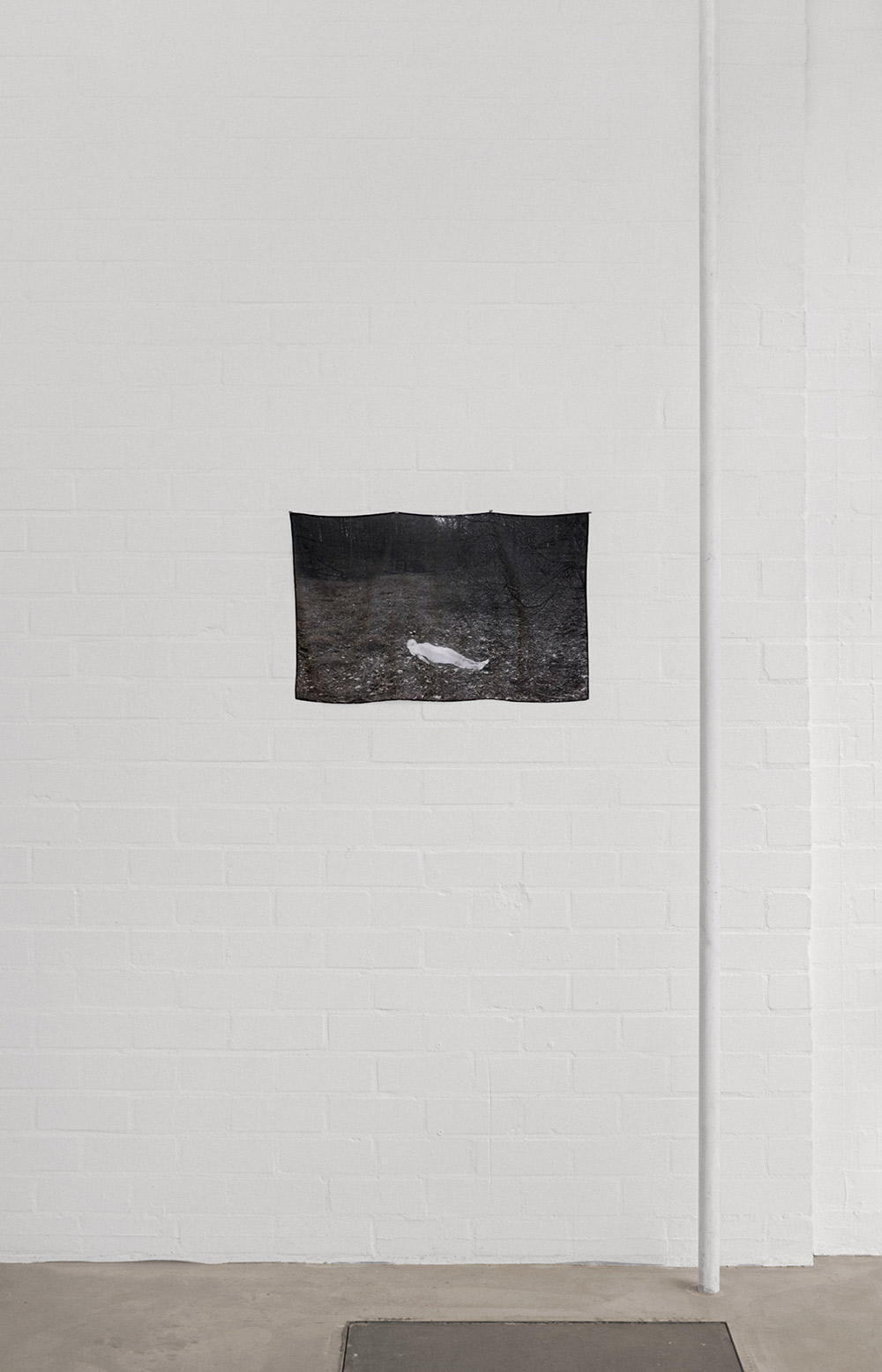
It starts with ice. Not permanence, not preservation — just ice, cast by Kelly Kroener as part of Metamorphosis (2022). Frozen clones sculpted from her body are placed in forests and fields, left to dissolve into the soil.
Their disappearance is deliberate, a process she carefully documents in photographs. The sculptures inevitably melt, but the photographs keep what the earth lets slip away. The series was born from her need to feel closer to the landscape. The casts are gestures rather than monuments, ephemeral forms meant to reimagine the body as part of a larger world. Whether it’s a crack in the earth or a memory folded into the ground, her work suggests that even what vanishes leaves something behind.
Kroener’s practice overlaps organic and industrial materials, utilizing her background in fiber, fashion, and technology to create installations that magnify humanity’s connection to the environment. These works reflect the tension between the body’s brief presence and the planet’s enduring rhythms. The melting ice starts a quiet back-and-forth between what disappears and what remains, nudging at the idea that nothing really lasts.
Time doesn’t stay in one place here. It moves like it’s trying to rewrite itself.